Daily Issues
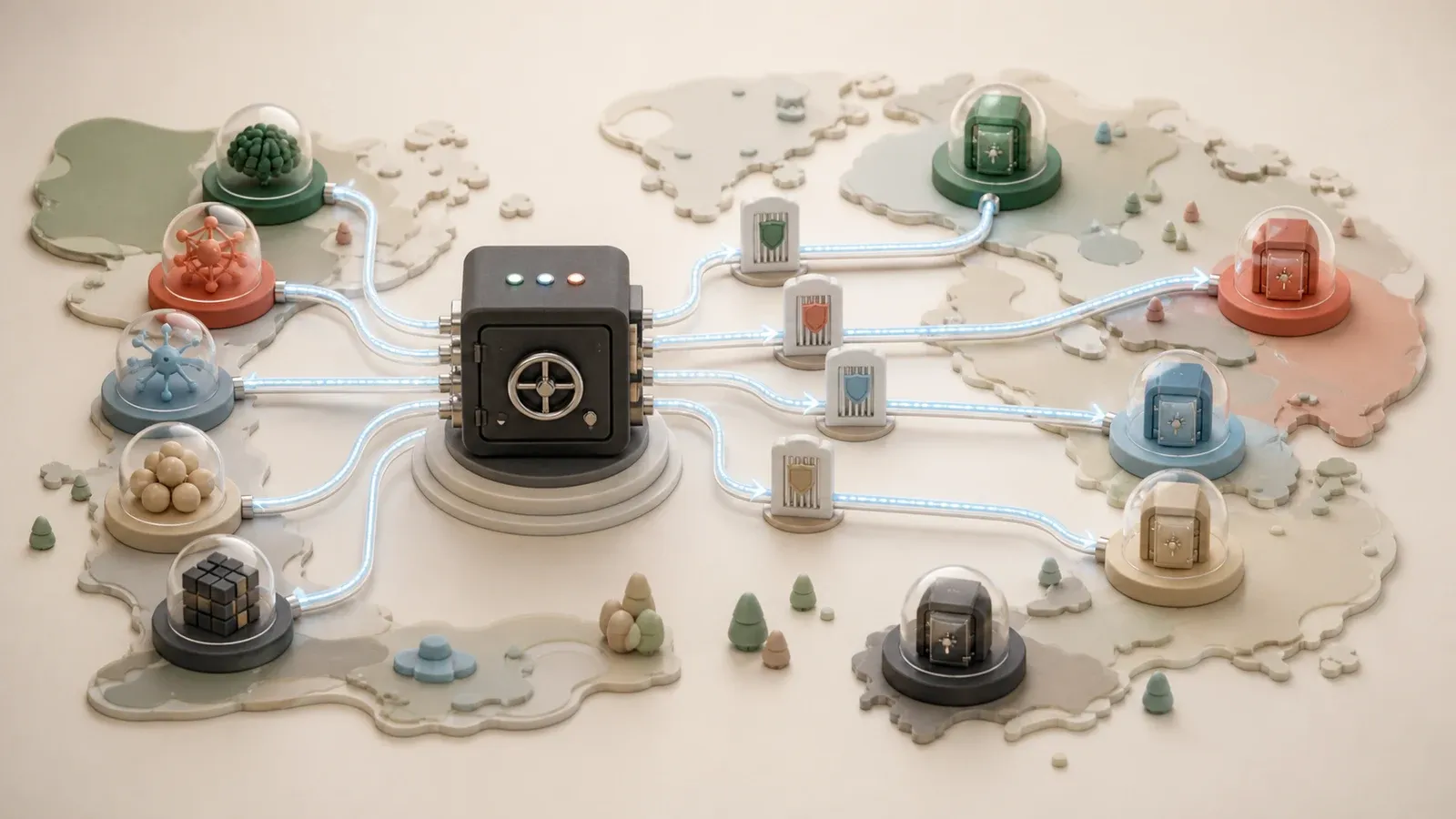
I Opened the Map First
A plain-language August 16, 2026 briefing on regional model routing, security verification, location policy, and hardware supply chains from a developer's point of view
Summary
At a glance
- Model, cloud, and data-location policies should be configurable as AI supply chains diverge by region.
- A vulnerability found by a security model needs reproduction and exploitability checks before it becomes evidence.
- Finance, local regulation, and logistics eventually reach API prices, feature availability, and hardware schedules.
This is my personal record for understanding markets, not a recommendation to buy or sell any asset.
Information cutoff: the morning of August 16, 2026, Korea time
Today I opened a map before I opened a model leaderboard. AI supply chains may split by country, a security model’s ability to find a bug was different from its ability to exploit one, and a financial service crossed a state line only to meet a different rulebook. The age of writing one stack and copying it everywhere seems to be packing its bags.
I also separated levels of certainty. Pax Silica and Korea’s participation are documented by the US and Korean governments. The Nvidia investment and Anthropic revenue forecast, however, come from reports based on unnamed sources, not finalized contracts or company guidance. GLM‑5.3’s figures are Z.ai’s own measurements and have not been independently reproduced. Facts on one news plate can have very different firmness. A buffet does not turn every dish into cast iron.
1. A global AI app needs a regional switchboard
Pax Silica is not only about AI models. It links semiconductors, critical minerals, energy, advanced manufacturing, and AI infrastructure. Korea’s foreign ministry said the second summit also discussed AI infrastructure security and semiconductor and critical-mineral supply chains.
An August 16 report said the US was considering a message that participation in the US-led framework may not be compatible with China’s rival arrangement. That is not a published final policy. Even so, the architecture worth preparing is clear:
region → allowed model → cloud and chip provider → data location → feature set
I would not scatter these rules across the application as if statements. I would keep them in a policy and routing layer, then define a fallback model and a user-facing explanation for each unavailable feature. Once I start painting conditions directly onto the world map, the brackets soon become more complicated than the borders.
Sources: US State Department Pax Silica fact sheet, Korean foreign ministry summit release
2. Separate “found a bug” from “can break in”
Z.ai said GLM‑5.3 scored 84.5% on CyberGym. A more attack-oriented evaluation still showed a meaningful gap, and the company said it would conduct roughly two weeks of safety review before releasing open weights. The figures have not yet been independently verified.
I would divide an AI-assisted security review into five steps:
- The model flags a suspicious location.
- A separate test reproduces the weakness.
- A sandbox measures the possible impact.
- A person reviews the proposed fix.
- The change merges only after regression tests pass.
A red circle from a model is not yet a fire alarm. Sometimes it circles the extinguisher simply because the extinguisher is red. I cover the technical controls in AI Technology: Finding Is Not Exploiting.
Sources: Axios on GLM‑5.3, CyberGym, Anthropic’s exploit evaluation research
3. Geofencing does not end with one map API
The supplied briefing presented Kalshi’s Nevada dispute as an August 16 development, but the official timeline shows that the court order and geofencing conflict had been unfolding since July. I therefore treat it as an operating case, not a new announcement today.
An IP-only geofence breaks down around VPNs, mobile networks, and address mismatches. GPS alone also produces false positives. A regulated financial service should combine IP, device location, SIM country, account address, and VPN signals into a risk score, then hold ambiguous transactions for review.
request → location signals → policy decision → allow, hold, or block → audit record
The appeals path matters as much as the block. If a legitimate customer is stopped and support replies, “According to the map, you are in the ocean,” both the technology and the conversation have gone off course.
Source: Nevada Gaming Control Board timeline
4. Rivers and guarantees also reach my deployment plan
The report that Nvidia may invest in SB Energy and revise financing support for an Ohio data center still describes negotiations. I cannot present it as a completed transaction. The broader direction nevertheless shows that AI cost is shaped by power, construction, and financing as well as tokens and GPUs.
Low water on the Rhine carries the same lesson. Reuters reported on August 14 that the navigation indicator at Kaub had fallen below its previous record and freight was moving to land transport. The figure is not the literal depth of the entire river. The potential effect on delivery times and costs for racks, UPS units, cooling systems, and power equipment is still real.
For a hardware-backed project, I would add three lines to the estimate:
- regional shipping lead time;
- alternate suppliers and component compatibility;
- sensitivity of cloud pricing to power and long-term capacity contracts.
The server may live in the cloud, but its delivery truck still uses a road.
Sources: Report on Nvidia and SB Energy talks, Reuters on Rhine low water, Kiel Institute low-water research
My developer checklist
- Keep regional, model, cloud, and data rules in configuration.
- Prepare feature-level fallbacks when one provider becomes unavailable.
- Do not combine detection, reproduction, exploitation checks, and patch approval.
- Design multi-signal geofencing together with a human appeal process.
- Add power, capacity financing, and hardware logistics to AI cost models.
My conclusion today is simple: before choosing a model, draw the borders the service must cross and the exits it may need. A model can change with one configuration line. Regulation and supply chains often change the meeting calendar first.
My market process is in Investment & Economy: I Read the Guarantee First.
Leaving a reaction may store a random identifier in this browser to prevent duplicates.