Investment & Economy
I Read the Guarantee First
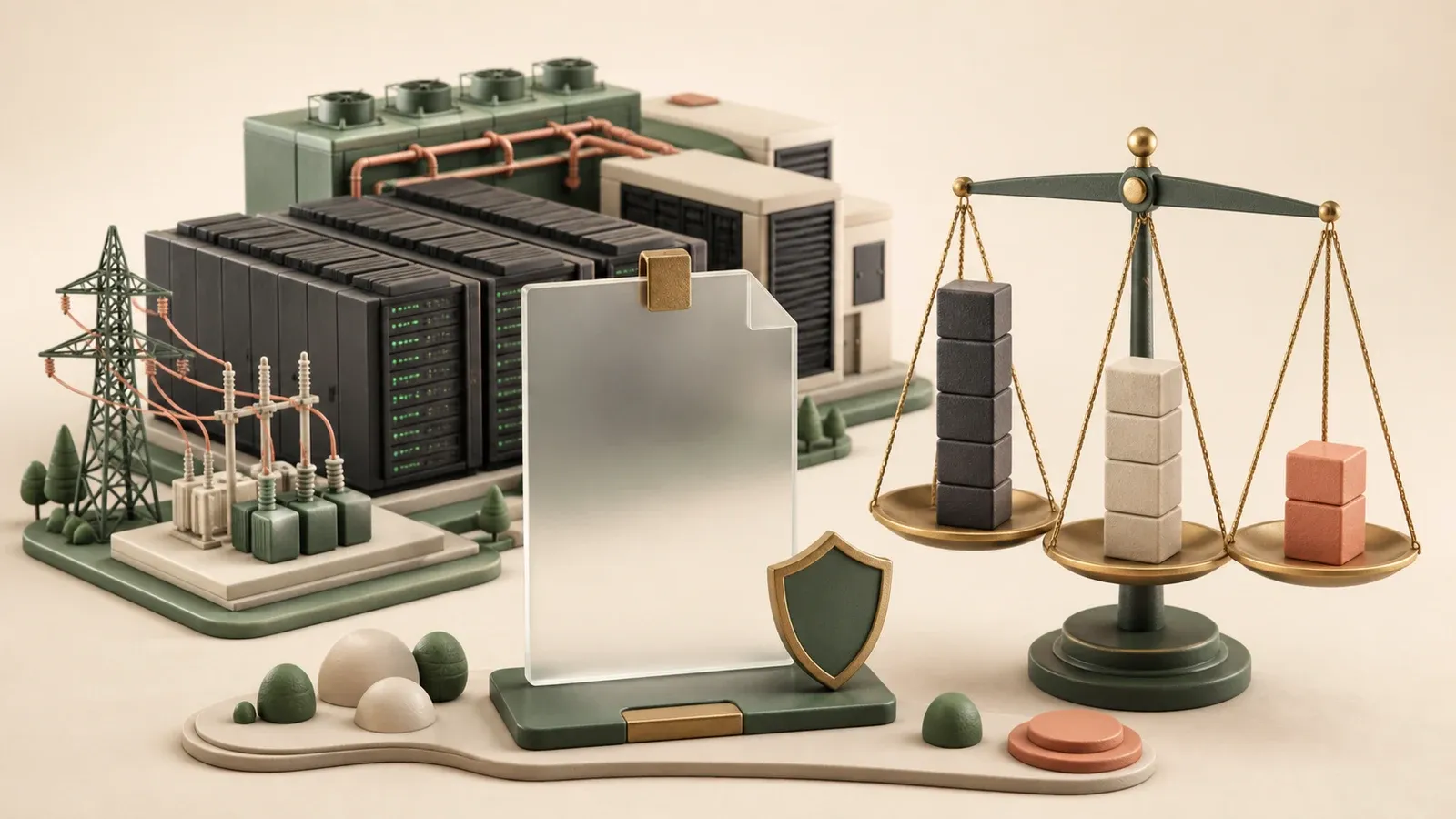
My investing process for separating reported Nvidia data-center financing and Anthropic forecasts from confirmed facts, then checking contracts, cash flow, and supply-chain risk
Summary
At a glance
- The reported Nvidia investment and smaller guarantee remain negotiations, not a completed transaction.
- Anthropic's reported 2028 revenue estimate is an internal forecast, not my single base case.
- AI investing requires attention to credit exposure, price declines, regional fragmentation, and logistics as well as chip demand.
This is a record of my market process, not a recommendation to buy or sell. The decision and its losses remain my responsibility.
Information cutoff: the morning of August 16, 2026, Korea time
Today I read the guarantee before the GPU benchmark. Reports said Nvidia was discussing an investment of up to $3 billion in SB Energy, developer of a large Ohio data center for OpenAI, while reducing a much larger form of credit support. Another report said Anthropic internally projected 2028 revenue of roughly $190 billion to $200 billion.
Both numbers are large, and neither is a finalized public filing. The Nvidia transaction is still reported as a negotiation, and Reuters said it had not independently confirmed the investment detail. The Anthropic number came from unnamed sources describing an internal forecast, not public company guidance. I wrote these figures in pencil and left the eraser nearby.
1. What it means to reduce a guarantee and add equity
If the reports prove accurate, Nvidia would move some exposure from a broad project backstop toward direct equity in the infrastructure developer. The risks differ:
- Credit guarantee: the obligation may become real if the project cannot perform.
- Equity investment: downside reaches the invested capital first, while upside is shared.
- GPU sales: revenue arrives sooner, but orders slow if customers cannot finance capacity.
A company acting as supplier, investor, and credit supporter can secure long-term demand. It can also gather several forms of risk onto one balance sheet. If a restaurant owner lends customers the dinner money and sells the kitchen equipment on credit, I need both the sales report and the tab.
Source: Report on Nvidia and SB Energy talks
2. A 2028 revenue number is a bundle of assumptions
The reported Anthropic forecast assumes a much larger market and substantial share. Reaching it would require usage growth while inference efficiency improves. Revenue growth alone is not enough if compute cost grows faster.
I do not discount one headline number. I use three scenarios:
| Scenario | Revenue growth | API pricing | Compute cost | What I watch |
|---|---|---|---|---|
| Optimistic | Usage and enterprise contracts surge | Gradual decline | Efficiency improves faster | Operating leverage appears |
| Base | Usage grows as competition rises | Continued decline | Grows near revenue | Cash flow needs proof |
| Conservative | Open weights and rivals pressure share | Sharp decline | Long contracts remain | Losses can grow with revenue |
One mistake I have made is reading high growth as high profitability. Revenue can take the elevator while cost runs up the stairs and arrives first.
Source: Report on Anthropic’s long-range revenue forecast
3. Korean semiconductors receive an opportunity and a split customer map
Pax Silica links semiconductors, critical minerals, energy, and AI infrastructure across a US-led partner supply chain. Korea participates. That can increase the role of Korean memory, materials, and equipment suppliers.
China remains a major production and sales market. If US and Chinese AI frameworks separate further, companies may not be able to sell the same product in the same way on both sides. I would examine:
- revenue and manufacturing exposure to China;
- products affected by US export controls;
- customer-level HBM and memory contracts;
- regional capex and subsidy conditions;
- duplicate cost created by supply-chain separation.
A split bloc does not automatically reward every Korean company. When the chairs move into two rows, a company standing in the middle first has to choose where to sit.
Sources: US State Department Pax Silica fact sheet, Korean foreign ministry summit release
4. Regulation and logistics create costs outside the revenue line
Prediction-market growth does not remove dependence on banking partners and local rules. Kalshi’s Nevada geofencing dispute is not a new August 16 event, but it is a useful case for including compliance cost in a financial-service valuation.
Low water on the Rhine is more physical. Reuters reported on August 14 that the Kaub navigation indicator had fallen below its prior record and freight was shifting to rail and road. The figure is not the literal depth of the full river, but the effect on chemical, metals, and energy logistics is real. Kiel Institute research estimates that a month with 30 low-water days is associated with roughly a 1% decline in German industrial production.
AI data centers also need cables, power systems, batteries, and cooling equipment. Even a good software business earns money on equipment with weight. Only the word “cloud” is light.
Sources: Nevada regulatory timeline, Reuters on Rhine low water, Kiel Institute research
My order of checks
- Wait for Nvidia investment and guarantee terms to appear in a contract or filing.
- Measure credit exposure and customer concentration around AI infrastructure.
- For Anthropic, watch gross profit and compute-cost growth, not only quarterly revenue.
- Split the 2028 forecast into optimistic, base, and conservative scenarios.
- Check regional revenue and duplicate supply-chain costs for Korean chip companies.
- Ask whether cash remains after logistics and compliance costs.
My boundary is simple: I will not count a reported negotiation as a confirmed asset, and I will not use one distant revenue forecast to justify today’s price. My conclusion is that when a chip supplier starts providing finance, the guarantee and cash flow deserve as much attention as sales growth.
The developer architecture for regional and provider separation is in Daily Issues: I Opened the Map First.
Leaving a reaction may store a random identifier in this browser to prevent duplicates.