A Small Room We Made Together: Why I Started Coco Room
A personal build log about the small space I wanted to make with my child, how AI shortened the prototype loop, and the boundaries I still want to protect.
Summary
At a glance
- Rather than trying to block the internet entirely, I wanted a small space where a child and I could choose what to explore and make.
- AI and vibe coding made it easier to test ideas quickly, but speed does not prove safety or quality.
- I describe the privacy and creative boundaries I want to keep, and why Coco Room began with a different problem than Ask.
This is a personal HaruSpace Lab build log. I have left out my child’s name, school, face, and routine, and I do not want one family’s experience to stand in for every child.
I did not think “close the screen” could be a lasting answer on its own. I could not keep my child away from the internet and video forever, and raising a child without digital media did not feel like the direction I wanted either.
One question stayed with me: when a child opens a screen, what appears first? Could we make a small place where a child can choose something they enjoy and stay with it for a while, instead of following one stimulating recommendation after another?
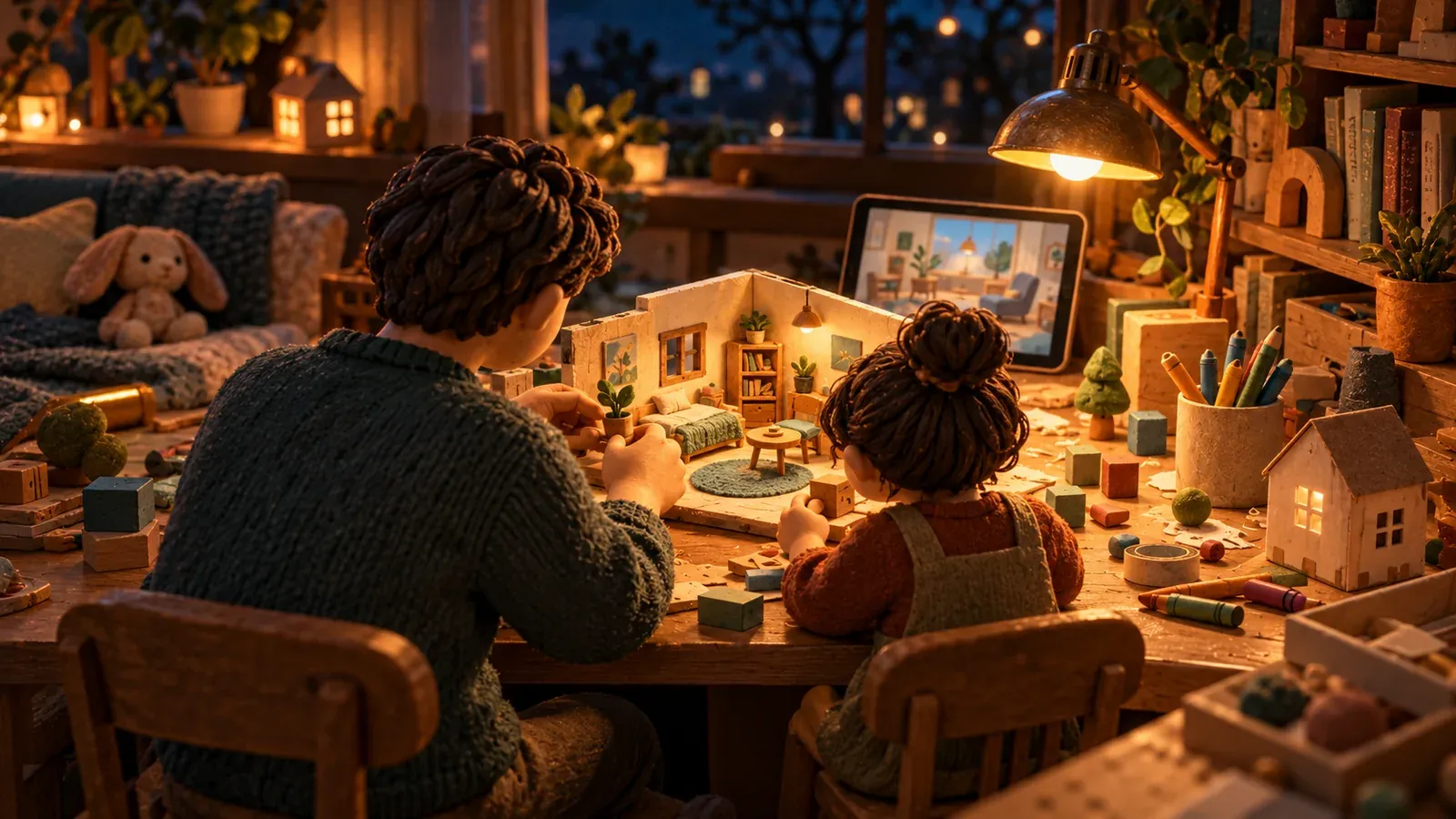
That was the thought behind Coco Room. I did not begin with a plan for a grand education platform. I wanted to make a place, one small piece at a time, where a child and I could arrange a room, meet characters, color, or try a little game.
I asked the child first
I did not decide every screen and feature before showing it to my child. I asked, “What would you like to have in here?” The answer might be a character, a space of their own, or an idea I had not thought of. I tried to listen before turning any of it into a design.
Then I made the smallest version I could and brought it back to the conversation. Rather than trying to finish everything at once, I made a draft the child could touch and react to. Hearing what felt right and what felt awkward gave me a clearer next step.
The distance from idea to screen got shorter
AI and vibe coding changed how long that feedback loop took. I used to imagine that planning, design, and implementation had to be prepared in a long sequence. Now I can turn a small idea into a rough screen, show it, and revise it more often.
It is still surprising to see yesterday’s conversation move on a screen the next day. But that does not mean AI knows what a child needs. Deciding what to build, whether it is appropriate to show, and what deserves another look remains my responsibility. A quick prototype helps me ask sooner; it does not prove that I have the right answer.
A small room still needs boundaries
Calling something a space for children does not make it safe by itself. Avoiding secondary use of a child’s activity, giving a guardian a chance to review creative work before it is shared, and letting a family choose what leaves the room matter as much as adding features.
That is why I do not want to say that I have finished “a safe internet for children.” The direction I want to pursue is narrower: focus on what a family chooses together, start with a limited sharing scope, and be honest about what we have not checked. One child enjoying one prototype is not evidence that it works for every family.
A small room cannot replace the internet. It can, however, be a place to begin asking what appears on a screen and what a child gets to choose or make with an adult nearby.
Coco Room did not simply turn into Ask
Coco Room is an experiment in making a place for children and families to play and create. Ask began with a different question: how might people answer a prompt, save something they discover, and find it again later? The projects are connected not by being the same feature, but by my wish to use the internet more intentionally.
I wrote separately about Ask’s path from a quick question to a personal library in From One Question to a Library: What I Want to Find Again in Ask.
Coco Room is still in progress. For now, I want to keep asking what responsibility comes with saying that a child helped make it. The first lesson from this small room is clear to me: even when we can build quickly, we should decide slowly what to put in front of a child.
Leaving a reaction may store a random identifier in this browser to prevent duplicates.