Investment & Economy
Orders Are Not Cash
A personal investment-process note separating CoreWeave's $104.2 billion backlog from its $35–39 billion capital-spending plan
Summary
At a glance
- A $104.2 billion revenue backlog is a strong demand signal, but it is not cash already collected or guaranteed profit.
- The $35–39 billion capex plan expands capacity while adding power, construction, refresh, and financing obligations.
- I will wait for backlog conversion, utilization, interest cost, and customer concentration before changing my position.
This is a record of my decision process, not a recommendation to buy or sell any company or asset. I remain responsible for my decisions and results.
Data cutoff: the morning of August 12, 2026, Korea time
CoreWeave’s figures surprised me twice: first with the revenue and order scale, then with the construction bill. AI infrastructure needs parallel arithmetic too. If I calculate only growth, the cost-side core is sitting idle.
1. Backlog is a reservation book
CoreWeave reported $2.575 billion of second-quarter revenue and $104.2 billion of revenue backlog. Both increased from the first quarter’s official figures of $2.078 billion and $99.4 billion.
Backlog is revenue that may be recognized under contracts over time. The conversion speed still depends on start dates, facility delivery, customer usage, and cancellation terms. I split it into three boxes:
- value written into contracts
- value attached to powered, delivered capacity
- value billed and collected in cash
A long waiting list does not mean the register is already full. It is still much better than having no customers. Both statements can be true.
Sources: CoreWeave’s official Q2 results, CoreWeave’s official Q1 results
2. $35–39 billion is growth spending paid up front
The company guided to $35–39 billion of capital expenditure this year. That money does not buy GPUs alone. It also funds buildings, grid connections, cooling, networking, and installation.
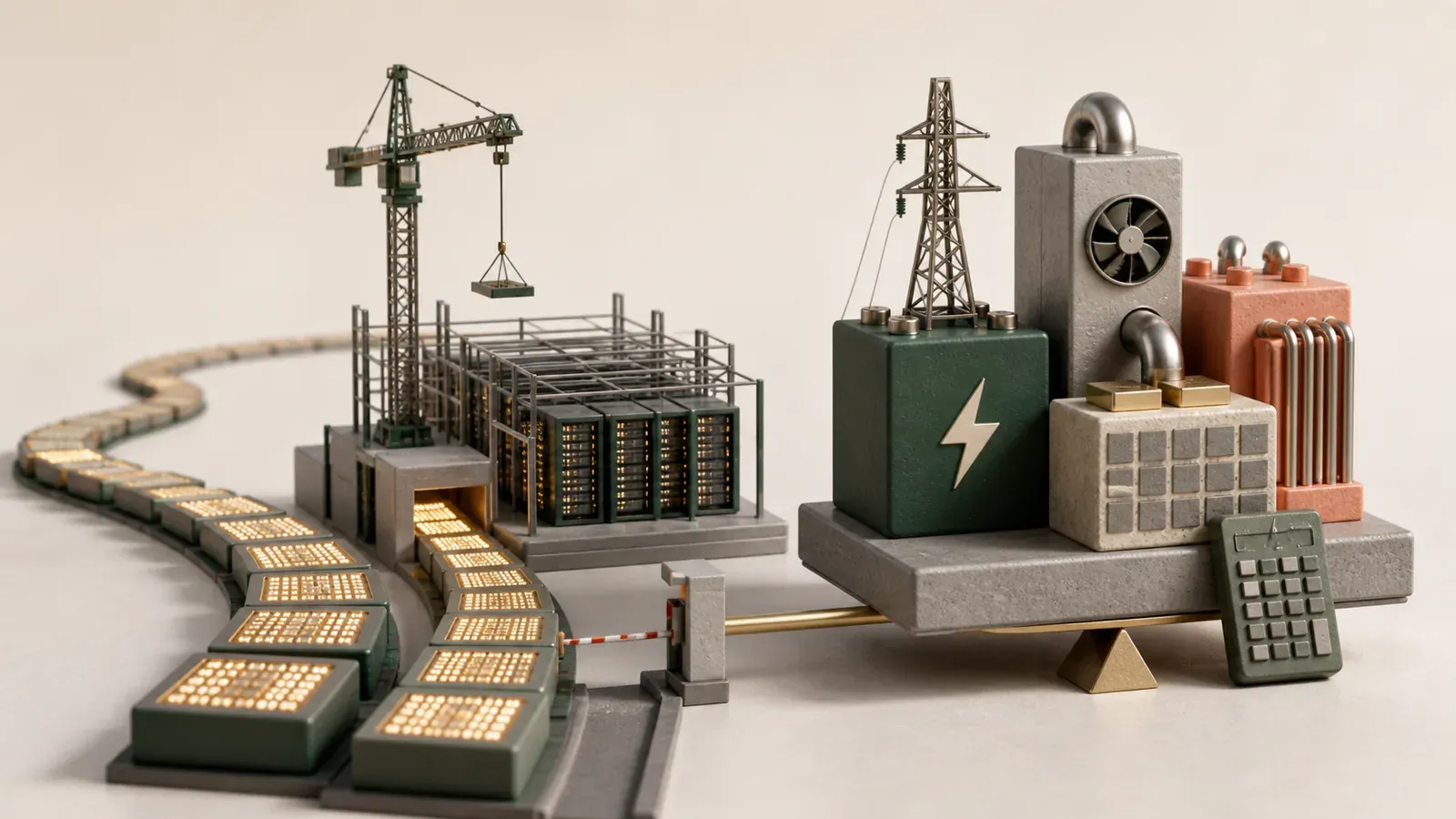
In the good case, capacity comes online and large contracts turn into revenue. In the bad case, demand slips or hardware generations change while depreciation and financing costs arrive first. The construction crane lifts future revenue—and the monthly interest bill with it.
3. I separate demand from financial safety
Strong AI demand does not automatically make CoreWeave’s capital structure safe. I therefore watch these alongside growth:
- backlog conversion into quarterly revenue
- active power versus contracted power
- GPU utilization and minimum-use terms
- concentration among the largest customers
- operating cash left after interest
- the cost of redeploying or refreshing older GPUs
I once translated “many orders” into “profit is secured” too quickly. My translator was fast; the income statement corrected it slowly.
4. A wider payment rail is not a token-price forecast
MoneyGram is widening a crypto-to-cash route connected to the Solana ecosystem. Its official Ramps page describes access across more than 170 countries. That is a real step toward usable payment infrastructure.
I do not turn it into a price target for any token. I want active-country coverage, actual transaction count, fees, compliance cost, failure rate, and repeat users. News of a new subway station and the net profit of every nearby shop belong on different sheets.
Sources: MoneyGram corporate news, MoneyGram Ramps
My risk boundary
I will not increase exposure to AI cloud or crypto infrastructure on today’s figures alone. Before the next decision, I want to see:
- new capacity becoming real revenue
- operating cash growing faster than capex and interest expense
- no single cluster of large customers distorting the whole picture
My conclusion is that the order book shows hope, while cash flow shows staying power. A growth story is a fine trailer. I want to know whether cash is still on screen when the end credits roll.
Leaving a reaction may store a random identifier in this browser to prevent duplicates.