The Day a Flying Car Became a Scene, Not Just an Idea
A brief Roadster thruster demonstration made an old flying-car image feel closer. I record what the scene shows—and what it does not yet prove.
Summary
At a glance
- “The first day” here is a personal marker for when an old idea appeared as a real demonstration, not a claim of historical firsts.
- The Roadster briefly lifted and moved in the air, but the demonstration did not establish sustained flight or everyday transport.
- I focus on the progress from vague imagination to a visible engineering possibility, not on launch or production plans.
Recorded: October 17, 2026, Korea time
For me, “the flying car” has long been shorthand for the future. The image of an ordinary road vehicle rising into the sky usually arrived first in films and drawings. It felt imaginable, but always far enough away to belong to a time other than the present.
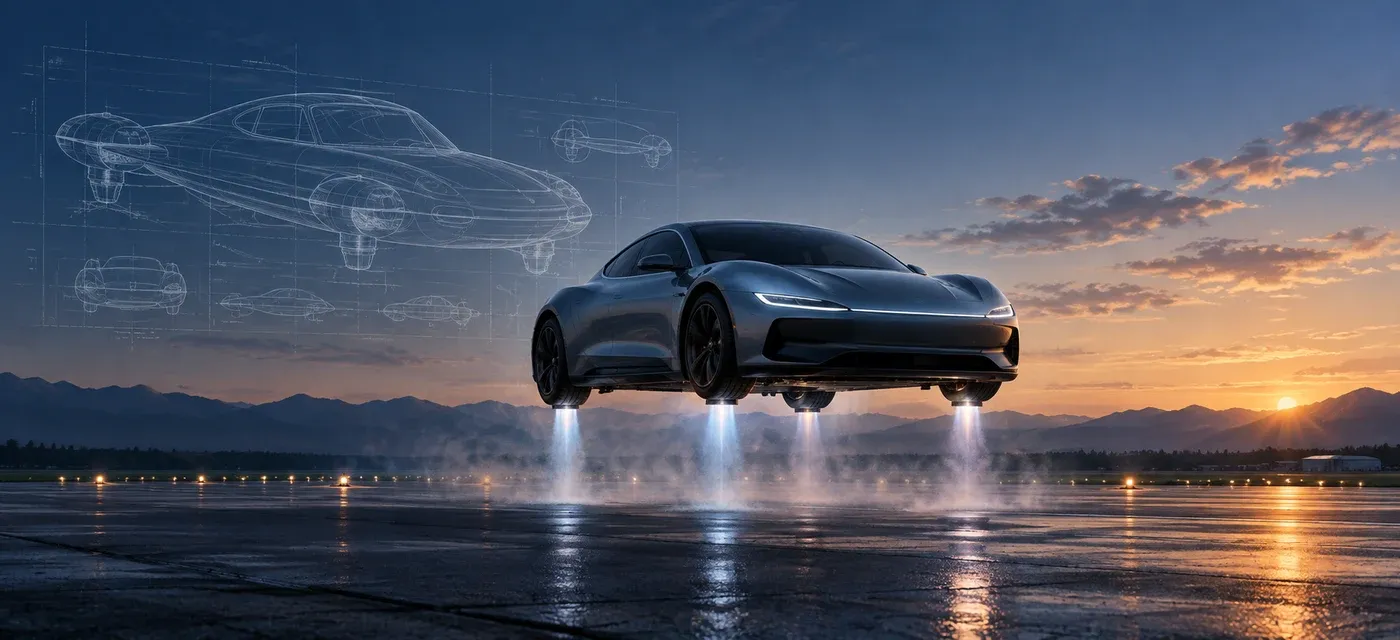
At an October 15 event, a next-generation Tesla Roadster briefly lifted and changed direction in the air using thrusters. AP and Reuters reported on the demonstration, which involved cold-gas thrusters and a suction system. Watching it, I felt a small shift: the question “Could this ever happen?” gave way, for a moment, to “So this is how far the attempt has come.” AP’s report, Reuters’ report
The moment that became “the first” for me
When I call this “the day a flying car first appeared,” I do not mean the first flying car ever built. I am not making a claim of historical priority. I mean the day, in my own record, when an old idea moved beyond an explanatory drawing and appeared as a demonstration of a car-shaped vehicle actually leaving the ground.
The vehicle was airborne only briefly. That brevity is part of what stayed with me. The future did not arrive as a finished product; it arrived as a small movement in the boundary of what seems possible. “A flying car,” once a vague phrase, became a specific engineering attempt whose propulsion and motion could be seen—and questioned.
Between lifting off and flying around
A cold-gas thruster expels compressed gas in one direction and gains force in the opposite direction. What the public demonstration showed was a thruster-equipped vehicle briefly lifting and moving in the air. That alone does not establish everyday flight or a safe means of transport.
There are many steps between lifting a car for a moment and carrying people reliably to a destination. Balance during takeoff, control under wind and changing loads, landing where intended, and safe responses to equipment failure all need separate proof. Where roads and airspace meet, protecting people and other vehicles is not a question engineering can answer on its own.
I want to remember the event as a demonstration of where technology has reached, not as proof that the challenge is complete. A short maneuver does not answer every question. It does, however, turn a vague phrase into an engineering problem that can be tested.
The future arrives as possibility, not a date
What held my attention was not when the car might be sold or how many might be made. It was the moment when the familiar assumption that a car belongs on the ground briefly gave way. Adding thrusters, lifting a vehicle, and changing its direction in the air made the boundary between automotive and aerospace engineering feel closer than before.
Of course, one visible demonstration cannot prove safety or usefulness. Yet technological change sometimes appears first not as a finished product, but as a scene that makes us think, “That might actually move.” The scene does not erase the work ahead. It changes the question: from whether it is imaginable to what conditions would make it safe and repeatable.
That change in the question is what I want to record. Flying cars have not become an everyday reality. Still, a future once confined to drawings briefly lifted off the ground with the sound of thrusters. For that moment, the future felt a little more present. This is not a record of waiting for a product launch; it is my note of wonder at an idea taking one step into a demonstrable technology.
Sources: AP on the demonstration and its limits, Reuters on the Roadster reveal. “First” is a personal marker in this essay, not a claim that this was the first flying car in history.
Leaving a reaction may store a random identifier in this browser to prevent duplicates.