Investment & Economy
A Working Developer Finally Starts an Investment Journal
I am restarting the investment notes and automated-trading experiments I kept postponing, using AI to help turn a long-standing interest into a practical routine.
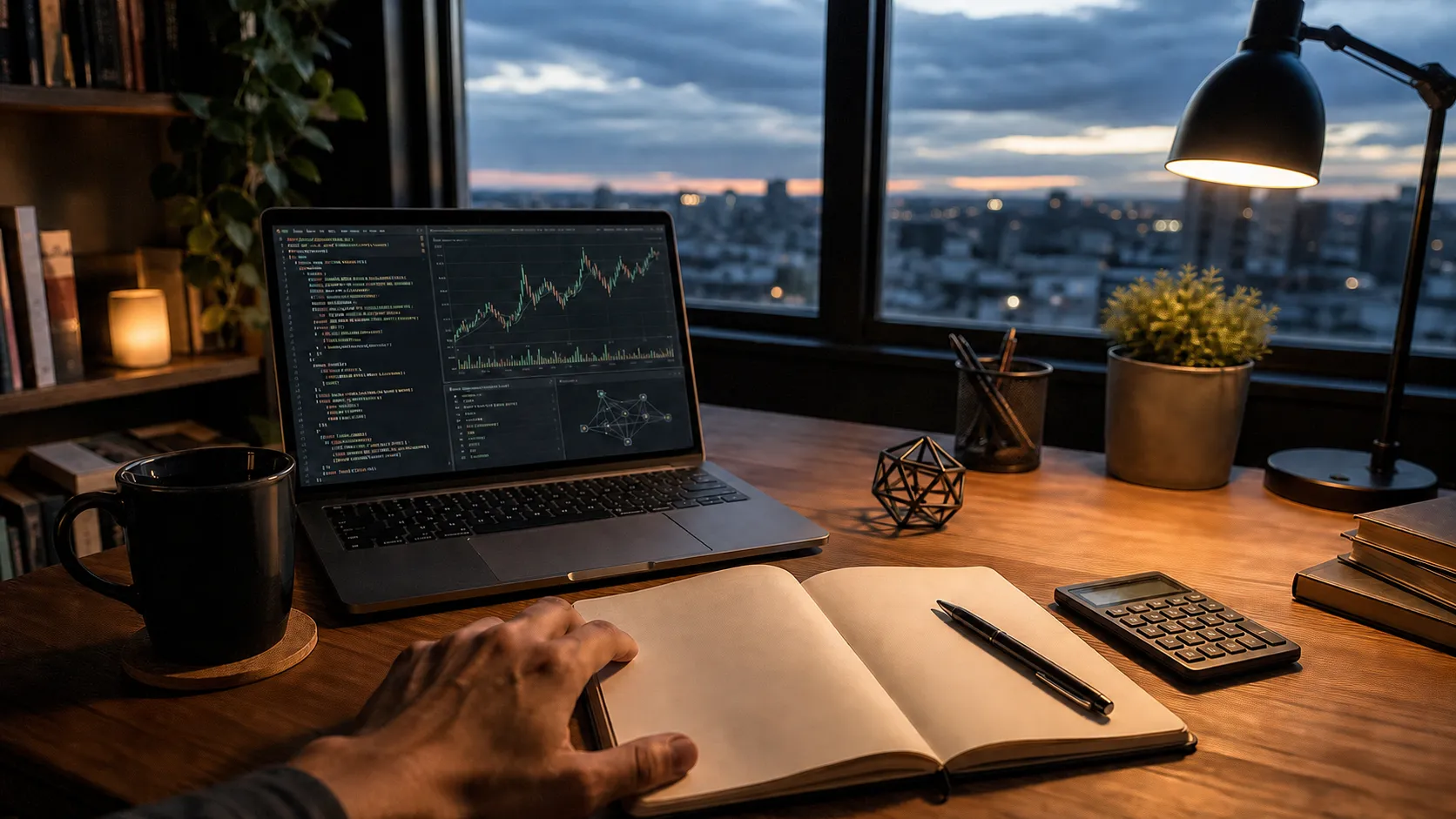
Summary
At a glance
- As a developer who enjoys technology, I am finally documenting my long-running interest in investing, blockchain, and automated trading.
- I want to use AI as a partner for organizing information and starting experiments, not as a machine that makes financial decisions for me.
- I plan to build a candid record of chart views, economic news, trade reviews, failed ideas, and the investment process I develop over time.
I am an office worker and a developer.
Most of my day is divided among code, schedules, and meetings. When a new technology appears, I get curious and usually need to try it myself before I can move on. That curiosity has never stayed neatly inside software. I have also been interested in investing for a long time: stocks, economic news, and, inevitably, blockchain. I am still not sure whether I should describe blockchain as an investment interest or a technology interest. For me, it has probably always been both.
The interest has been there for years, but the record has not. In a good market I was too busy watching prices. In a bad one I did not particularly want to reopen my mistakes. Automated trading followed the same pattern. I would write down an idea, build a small piece of code, and then stop somewhere around data cleanup or validation. Sitting down after work and restarting the whole process was harder than I liked to admit.
Why I made this space
I want this section to hold both the way I think about investing and what actually happens when I test those thoughts. I am less interested in displaying a perfect profit curve than in keeping a record that lets me return to a decision and see what I missed.
I plan to write about the rules behind a chart view, why one line in an economic story caught my attention, and how far the result of a trade drifted from my original reasoning. If I restart my automated-trading work, I want to include not only strategy ideas but also data collection, backtesting, order conditions, and experiments that failed. Recording only the final result makes it far too easy to miss the habits that keep repeating underneath.
Using AI to begin work I kept postponing
In the past, automation meant finding source material, cleaning data, writing code, and debugging every step in sequence. The list of chores could become visible before the first useful experiment did. AI can now reduce some of that friction. It can help me organize the context around a news story, turn an idea into a rough implementation, and point out conditions I may have forgotten.
I do not think that means AI should make the investment decision. That is an attractive and dangerous misunderstanding. I still have to ask what data is missing, whether a backtest has simplified reality too aggressively, and whether I am choosing only the evidence I want to believe. AI may make the first step lighter and experiments faster, but it does not take responsibility when real money moves.
That division of labor is enough for me. Instead of waiting another few years for a perfect system, I want to restart with one small strategy, one test, and one honest record.
Investing in a noisy world
Open the news and natural disasters, wars, interest rates, currencies, supply chains, and policy changes all arrive on the same screen. Markets rise and fall before anyone has finished explaining why. Yesterday’s common sense can become today’s dangerous certainty. Honestly, it feels harder every year to claim that I know what comes next.
Still, this confusion is part of the environment we have to adapt to. Trying to predict every variable feels less useful than deciding what I can afford to risk, defining where I stop when I am wrong, and leaving a trail of how I reached a decision. In development, a problem without logs is difficult to reproduce. In investing, a mistake without a record tends to return under a different name.
What I plan to leave here
I will not force this journal into an impressive master plan. I would rather begin with the questions that are real to me now.
- The view I formed from a chart and what happened afterward
- How economic news influenced both the market and my own judgment
- The reason for a trade, its result, and the review that followed
- Automated-trading ideas, backtests, and small implementations
- Failed assumptions and the rules I changed because of them
These posts are personal notes from one working developer, not instructions to buy or sell anything. I want to record uncertain decisions and unremarkable experiments alongside the successful ones. Over time, I hope this becomes less a display of returns and more an honest account of how I learned to think and adapt.
The world will remain noisy, and markets will keep riding their roller coaster. I will be wrong more than once. This time, however, I do not want to let interest remain only an interest. I want to write one line and run one small piece of code.
This post is the beginning.
Leaving a reaction may store a random identifier in this browser to prevent duplicates.