Daily Issues
A 39°C heat forecast and AI labels made me think about the duty to warn early
Heat alerts, AI transparency rules, an uneven global outlook, and dementia guidance all reminded me that risk and uncertainty must be visible before people can choose.
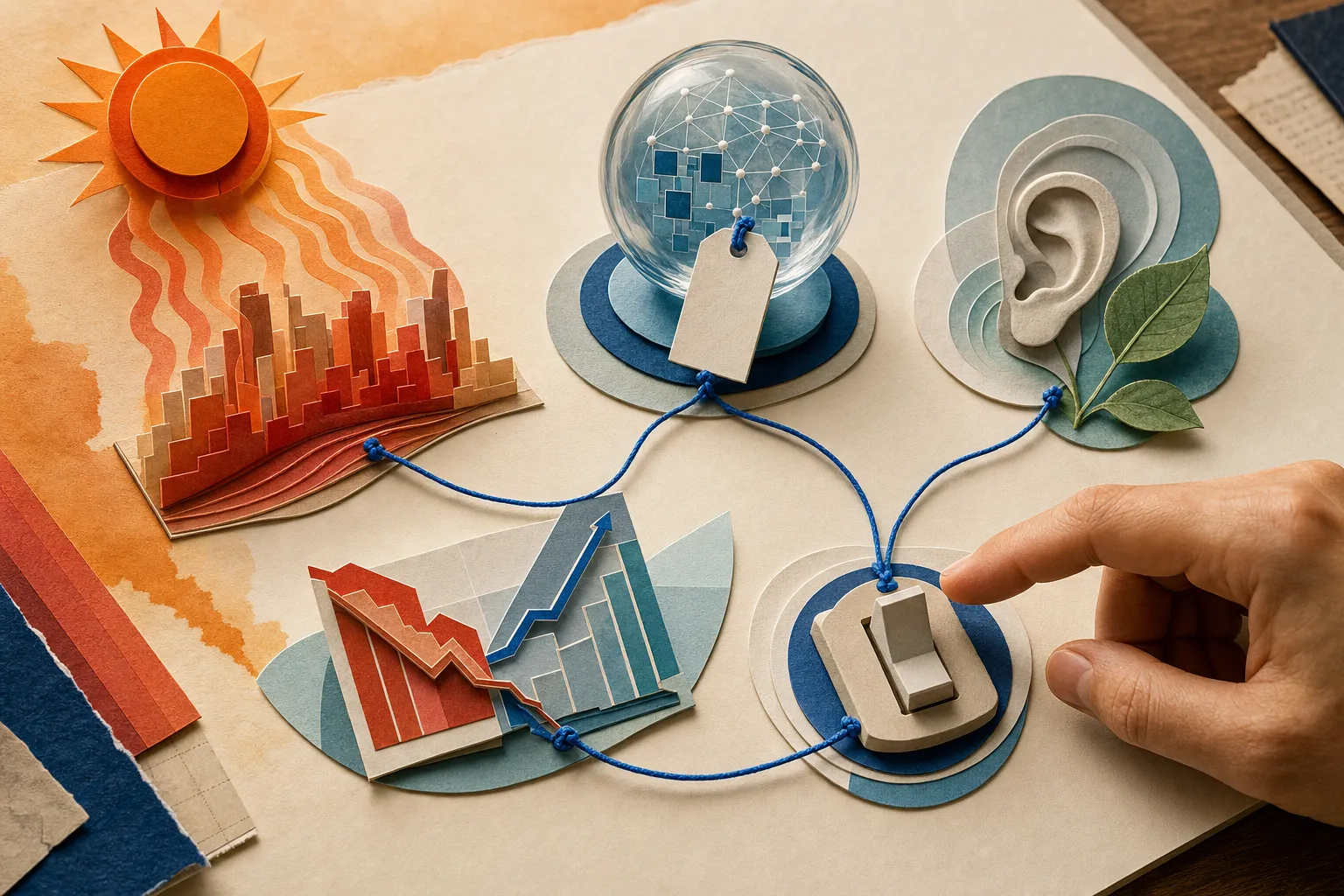
Summary
At a glance
- A forecast of 39°C in parts of Korea and heat-illness data made me treat extreme heat as a reason to change work and schedules.
- I read the EU's AI transparency duties as a way to return useful judgment to people, not simply as a regulatory label.
- The larger a growth or prevention figure looks, the more carefully I want to record its assumptions and limits.
This morning I moved back and forth between four reports that appeared to have little in common. One was a heat alert from the Korea Meteorological Administration. Another concerned the European Union’s duty to identify certain AI interactions and outputs. The IMF had growth and inflation figures, while the WHO had a number about reducing dementia risk.
At first, putting all four into one post felt forced. By the end, however, they had left me with the same question.
People can make a real choice to pause or proceed only when risk and uncertainty are visible to them.
A good system should do more than produce an answer quickly. It should show what may be dangerous, which assumptions sit behind a number, and where a person must perform the final check. That is the thought I want to preserve today.
A forecast of 39°C should change a schedule, not merely provoke a reaction
The Korea Meteorological Administration’s heat update on the morning of July 31 said apparent temperatures around 35°C would continue across much of the country. Parts of Busan and South Gyeongsang Province, including Yangsan, Changwon, and Gimhae, were forecast to reach either 39°C in air temperature or a maximum apparent temperature of 38°C. Tropical nights had continued in many places. The Ministry of the Interior and Safety had already raised the heat crisis alert to “serious” and activated the Central Disaster and Safety Countermeasures Headquarters on July 27.
According to the Korea Disease Control and Prevention Agency’s emergency-department heat-illness surveillance, 1,399 heat-illness cases and eight suspected deaths were reported from May 15 through July 26. Outdoor locations accounted for 81.8% of the cases: workplaces for 26.2%, fields for 15.9%, and roadsides for 12.4%. People aged 65 and over accounted for 30.2% of patients. These are provisional reports from a surveillance system rather than a final count of every case. They are still heavy enough to show where risk is accumulating.
I spend most of my working day indoors, looking at a screen. That makes it easy to see a red number in a weather app and reduce it to “another hot day.” Someone else is delivering packages, standing at a construction site, or working in a field at the same hour. A room with air conditioning and an exposed worksite cannot give the same meaning to 39°C.
Today I want to treat the number as an operating threshold, not a description. That means postponing nonessential outdoor plans, making water and cooling breaks part of the work conditions rather than a matter of personal endurance, and checking on older relatives or neighbors first. The KMA’s advice to move a person with symptoms such as dizziness or impaired consciousness to a cool place and call 119 is not a sentence to skim. I need to stop treating endurance in extreme heat as evidence of diligence.
An AI disclosure looks more like a right to judge than an inconvenient label
The European Commission has published guidelines on the transparency obligations in Article 50 of the AI Act. The obligations apply from August 2, 2026. Certain AI systems that interact directly with people must disclose that interaction, and providers must add machine-readable markings to generated or manipulated content. Deployers also have disclosure duties for deepfakes and for AI-generated text that informs the public on matters of public interest when it lacks human review or editorial control.
This does not mean that every AI output receives the same visible sticker. The duties have a defined scope and different methods of implementation. The Commission’s quick facts page also notes a grace period until December 2026 for the marking obligation of some generative systems already on the market. I am not a lawyer, so I will not pretend that these EU rules can simply be copied into a Korean service.
I do agree with the direction. People need more than a generic warning that says, “Do not trust this because AI was involved.” They need enough information to distinguish what was generated from what a person checked. Only then can they decide whether to seek another source, pause an important decision, or ask a responsible person.
This article was also organized and translated with AI assistance, and its cover was generated specifically for it. I have placed official sources close to the claims, recorded the generated image’s rights and approval metadata, and kept the final publication decision with the person who merges the pull request. That does not prove perfection. It is a boundary that prevents automatic generation and automatic publication from becoming the same operation.
Global growth of 3.0% does not guarantee that my wallet is safe
The IMF’s July 2026 World Economic Outlook update projects global growth of 3.0% in 2026 and 3.4% in 2027. It says AI-related demand is benefiting economies in the technology supply chain, while the war shock is placing a heavier burden on energy importers and vulnerable economies. Disinflation has stalled, and the IMF lists an escalation of conflict and a repricing in financial markets among the downside risks. In its opening remarks for the release, the IMF said its global headline inflation forecast for 2026 had been revised up to 4.7%.
The 3.0% figure can make the world economy look more resilient than expected. That average, however, includes both places benefiting from AI investment and places being hurt by energy prices. The 4.7% figure is not the same as the increase in my own cost of living either. The experience varies widely by country, income, and spending pattern.
I like technology and I am interested in investing, so a forecast like this immediately tempts me to hunt for an opportunity. That is exactly when I try not to use a forecast as a buy or sell signal. A growth projection is a scenario built on assumptions. Market prices can move before that scenario or in a completely different direction.
The useful record is not “the IMF said growth would continue.” It is what I assumed, what evidence would prove me wrong, how much loss I could bear, and how much cash flexibility I kept. Writing the limits of my judgment beside the number helps me avoid rewriting my memory after I see the result. This is not investment advice. It is a personal rule for staying accountable to my own decisions.
“Up to 45%” describes room for prevention, not a promise of a cure
On July 15, the WHO released updated guidance on reducing dementia risk. More than 57 million people live with dementia worldwide, and nearly 10 million new cases occur each year. The WHO says up to 45% of dementia risk may be attributable to modifiable factors including tobacco use, harmful alcohol consumption, social isolation, physical inactivity, air pollution, hypertension, and diabetes.
The phrase “45%” does not mean that changing a habit gives an individual a 45% chance of avoiding dementia. It is an estimate of the share of risk factors at a population level, and individual circumstances vary with age and health. The guidance emphasizes physical activity, social connection, a healthy diet, and the management of chronic conditions. It says hearing aids may be offered to people with hearing loss. It does not recommend vitamins B or E, omega-3 supplements, multivitamins, or minerals for people without a diagnosed deficiency because evidence that the benefits outweigh harms is lacking.
Large prevention figures move me quickly when I think about my family. I also feel the temptation to buy or take something now simply because action seems to quiet anxiety. What stayed with me in this guidance was not a special product but the connection between ordinary life and appropriate care: noticing whether hearing has changed, whether isolation is growing, and whether blood pressure and blood sugar are being followed. Personal decisions belong in a conversation with a clinician, but I can create a reason not to postpone that conversation.
The three rules I am taking from today’s four issues
Extreme heat, AI disclosure, economic forecasts, and health guidance belong to different fields. In my notes this morning, they came together in three lines:
- Before reacting to a large number, ask whether it should change what I do.
- Keep sources, assumptions, uncertainty, and the point of human review close to a generated result.
- Treat warnings as a core feature that protects choice, not as friction added to the user experience.
I want to apply the same rules while building HaruSpace and Haru Journal. Even as AI takes on more work, publication should retain a human approval point. Facts should keep their sources nearby. In areas where outcomes carry more weight, such as health and investing, limits should come before confidence.
None of this morning’s reports said the world had become safe. They did show what must become visible before a person can make a safer decision. I intend to keep recording that difference.
Leaving a reaction may store a random identifier in this browser to prevent duplicates.