Daily Issues
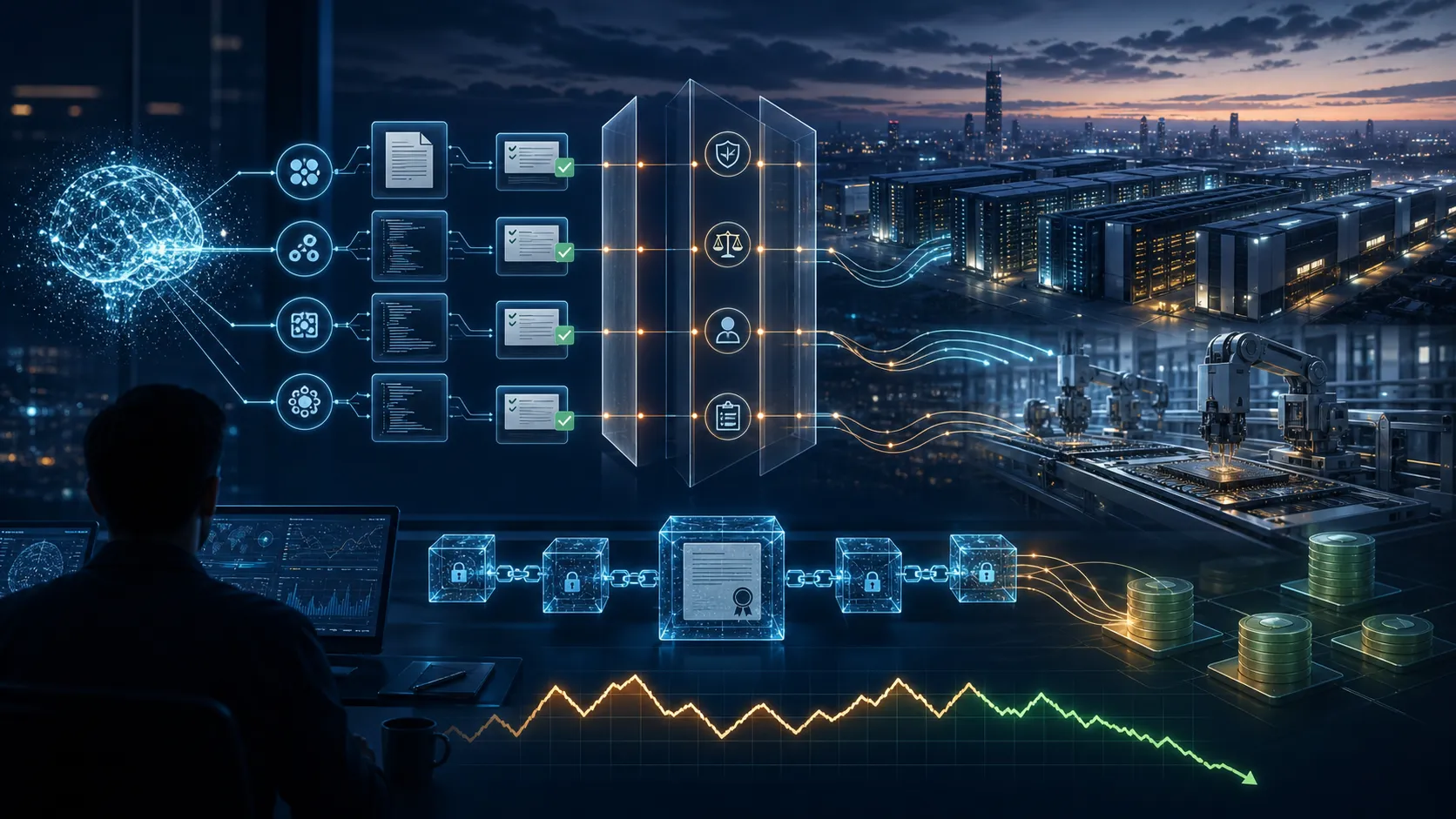
AI competed beyond the model while markets moved in different directions
An August 6, 2026 briefing on coding agents, AI infrastructure, enterprise cloud, stablecoins, central banks, gold, and the KOSPI—separating facts from uncertainty

Summary
At a glance
- Long-running coding agents are beginning to compete on recovery, isolation, execution history, and observability rather than a single answer.
- AI demand is visible in server manufacturing and enterprise IT orders, but revenue, margins, and investment returns remain separate questions.
- Central banks and gold, U.S. equities, and the KOSPI sent mixed signals, making volatility control more useful than a one-direction narrative.
Investment commentary in this article is market-analysis information, not a recommendation to buy or sell any asset.
As of the morning of August 6, 2026, Korea Standard Time
Today I focused less on collecting the largest number of stories and more on refusing to force conflicting signals into one neat line. Coding tools are trying to work longer and execute more safely. AI spending is appearing in server and enterprise-cloud revenue. Interest rates and asset prices, meanwhile, did not fit cleanly into either “risk-on” or “risk-off.”
I excluded the AMD, SpaceX, and Arista results, the GitHub Spark retirement, centralized CodeQL policy, Wells Fargo tokenized deposits, U.S. crypto political funding, Bank of Korea minutes, and the previous session’s equity and oil moves covered yesterday. When I could not verify a number directly in an official release, I removed it or stated the verification limit. A long briefing is still better than giving an uncertain number a confident costume.
My main judgment today
The center of competition is moving a little further from model names toward operational ability. Where a long task resumes, how generated code is isolated, and whether every change can be traced are now part of the product.
The market picture was more complicated. AI demand showed up in server revenue and enterprise IT orders, but more usage did not automatically mean more profit. Central banks did not read the same script, and gold, the Dow, the Nasdaq, and the KOSPI moved for different reasons. My conclusion today is separation before prediction.
1. Meta Muse Code: a long-running agent needs memory and recovery
Meta introduced Muse Code, a beta terminal coding agent built on Muse Spark 1.2. According to the company, it can run subagents in isolated workspaces and use a persistent local activity record to recover interrupted work. Published pricing is $1.25 per million input tokens and $4.25 per million output tokens.
What interests me is not the claim that it generates a good piece of code once, but how it continues a job. In a large repository, an intelligent model still creates substantial human cleanup when several agents touch the same file or an execution stops halfway through a test. Isolated workspaces and persistent history target that unglamorous problem directly.
These are Meta’s product claims at this point. I would judge the tool on large-repository navigation, test pass rate, recovery after failure, the number of unrelated files changed, and the time a person spends repairing the final result. A low API price is not cheap if rollback time rises.
Sources: Meta AI — Introducing Muse Code and Muse Spark 1.2, Meta AI model documentation
2. Cloud Run Sandbox: I read the boundaries before the feature list
Google Cloud offers Cloud Run Sandbox in public preview for Cloud Run services, providing an isolated environment for AI-generated and otherwise untrusted code. Its official description says a sandbox cannot access environment variables or the metadata server, denies outbound networking by default, and uses an ephemeral writable layer over a read-only filesystem.
The supplied draft said support had expanded across Jobs and Worker Pools. At publication time, I could verify Cloud Run services in the official release notes and documentation, so I did not broaden that scope. With a new security feature, writing one fewer line is better than inventing one more boundary.
A feature named Sandbox does not complete the security design. If I run generated code, I still want CPU, memory, and time limits; an outbound network allowlist; no injected secrets; minimum readable data; post-job cleanup; and audit records. Isolation is a stack of boundaries, not a badge.
Sources: Google Cloud — Cloud Run sandboxes are in public preview, Cloud Run code execution documentation, Cloud Run release notes
3. Foxconn: AI-server demand was visible, but I waited on an unverified July number
The latest detailed figure I could verify directly on Foxconn’s official monthly page while writing was June revenue of NT$821.763 billion, up 52.11% year over year. The company described strength in cloud network products, and second-quarter revenue reached NT$2.513 trillion, up 39.8% from a year earlier. AI-server demand is clearly traveling beyond chip designers into assembly, rack integration, power, and cooling.
The supplied July figure—NT$946.5 billion and 54.2% growth—appeared on Foxconn’s calendar as an August 5 scheduled release, but I could not yet verify it in the detailed official monthly table I checked. I therefore kept the confirmed June and quarterly figures instead of using a record high that would make a better headline.
For developers, GPU count alone is not a throughput plan. Network bandwidth, power ceilings, cooling, rack validation, delivery schedules, and software stability must align. For investors, revenue growth must be separated from manufacturing margins, customer concentration, and whether AI sales improve operating margin. “Sold more” and “kept more” belong in different columns.
Sources: Foxconn monthly revenue, Foxconn investor calendar, Foxconn second-quarter revenue report
4. European enterprise IT: integration and sovereignty opened the wallet
OVHcloud’s Public Cloud revenue was €65.6 million in fiscal Q3 2026, up 20.2% on a like-for-like basis. The company also announced its selection as a sovereign-cloud provider for EU institutions. SAP reported current cloud backlog of €22.9 billion in Q2, up 26% at constant currency. Capgemini said generative and agentic AI exceeded 11% of group bookings in Q1.
I read these figures as evidence that enterprises are moving beyond buying model access. Real deployments must connect ERP, internal data, user permissions, audit logs, and policy. In Europe, the jurisdiction and operator governing the data can also be a purchase condition.
That means model-call code may be a smaller part of an enterprise AI project than data lineage, inherited authorization, row-level controls, and rollback. Existing ERP, consulting, and sovereign-cloud providers have an opportunity, but AI may also compress repetitive consulting work and pressure labor-based revenue. The label “AI beneficiary” cannot explain both sides by itself.
Sources: OVHcloud fiscal Q3 2026 results, SAP recent results, Capgemini Q1 2026 revenue
5. Circle: USDC activity and earnings did not run at the same speed
USDC in circulation reached $73.3 billion in the second quarter, up 19% year over year, while onchain volume rose 151% to $14.8 trillion. Circle’s total revenue and reserve income increased 7% to $701 million, including $668 million of reserve income. The reserve return rate declined 66 basis points from a year earlier.
The important point is the gap: activity rose sharply while revenue grew much more slowly. A stablecoin issuer’s short-term results depend not only on circulation but also on the yield earned on reserves. I need to separate evidence of product use from the assumption that shareholder returns grow at the same speed.
As a developer, I think first about confirmation depth, chain reorganizations, transfers on the wrong network, address risk, duplicate payments, and refund procedures—not merely a transfer API. The exception list grows with circulation. As an investor, I would watch real payment use and circulation together with rate sensitivity, fragmented liquidity, and smart-contract risk.
Source: Circle — Second quarter 2026 results
6. Central banks: Brazil, India, and the United States did not share a script
After reducing the Selic rate to 14.25% in June, Brazil’s central bank held it at 14.25% in August. The supplied draft’s cut to 14.00% and fourth consecutive reduction did not match the official decision, so I corrected it. The rate remains a financing burden for local data centers and fintech, while one hold is not enough to settle the long-term path.
The Reserve Bank of India also held its policy rate at 5.25%. Here I find oil pass-through, the rupee, data localization, and local payment requirements such as UPI more useful than a single growth number. A growth market does not automatically have simple system requirements.
The Federal Reserve held its target range at 3.50%–3.75% in July, while three participants preferred a 25-basis-point increase. ADP, meanwhile, estimated 44,000 private-sector jobs added in July. Inflation kept the hawkish guard up while private employment suggested slowing. ADP is not the Bureau of Labor Statistics employment report, so I did not turn those signals into a precise probability for the next meeting.
Long-term GPU purchases and infrastructure contracts are not decided by technical usage alone. Financing costs, currencies, and supplier stability belong in the same quote. For my work, a contract that survives a wrong rate forecast is more useful than correctly guessing the next meeting.
Sources: Central Bank of Brazil Copom statements, Reserve Bank of India, Federal Reserve July 2026 FOMC statement, ADP National Employment Report
7. Gold and U.S. equities: risk signals split on the same day
On August 5, gold surged roughly 4% intraday and moved above $4,200 an ounce, with the exact figure varying by timestamp and data feed. The Dow rose 0.5% that day while the Nasdaq fell 0.8%. Gold strength, gains in part of the equity market, and technology weakness appeared together.
Calling the scene simply risk-on or risk-off erases the useful differences. Gold reacts to the dollar, real rates, institutional demand, and position unwinding, while equities respond to earnings and sector valuations. A roughly 4% daily move in gold can reinforce a trend, but it can also contain short covering and crowded positioning.
If I were building an investment-information product, I would not flatten several assets into one fear-and-greed value. A simpler display does not make the causes simple.
Sources: World Gold Council — gold price data, AP — U.S. market close on August 5
8. The KOSPI rebound: I separated one day’s speed from the industry’s direction
The KOSPI rebounded roughly 4% on August 5, led by large semiconductor names including Samsung Electronics and SK hynix. It can be read as a sign that long-term expectations for AI servers, HBM, and memory demand remain. Recent large swings, however, also reflect deleveraging, bargain buying, and positioning rather than fundamentals alone.
I do not treat one strong rebound as proof that the market has stabilized. Semiconductor demand and the temperature inside an investment account can differ even on the same day. When buying AI infrastructure, I would look at delivery time, memory capacity, power and cooling, and software compatibility rather than the share price. When investing, I would set the volatility I can absorb before worrying about missing a rebound.
Source: Korea Exchange Data Marketplace
The judgments I am keeping today
- Evaluate a coding agent on recovery, isolation, conflict handling, and observability—not one answer.
- Even when AI demand appears in revenue, verify margins and return on investment separately.
- When rates and asset prices diverge, separate the timing and cause of each signal instead of inventing one grand narrative.
My one-line conclusion is this: AI demand remains visible in servers and enterprise IT orders, but the market is beginning to judge execution stability, integration ability, and actual retained profit more strictly than a model or chip name.
Investment commentary in this article is market-analysis information, not a recommendation to buy or sell any asset. Every investment decision and its consequences remain the investor’s responsibility.
Leaving a reaction may store a random identifier in this browser to prevent duplicates.